Posterior Cingulate Cortex — Function, Location & Quiz
Posterior cingulate cortex is one of the brain’s most consistently active regions when attention is not fixed on an external task. As a default mode network hub, it links autobiographical memory and self-referential thought rather than representing simple inactivity.
It is easy to confuse with anterior cingulate because both share the cingulate name. Their emphases differ: anterior systems flag conflict, pain and control demands, while posterior systems are more closely tied to internally directed memory and navigation—and show early metabolic change in Alzheimer’s disease.
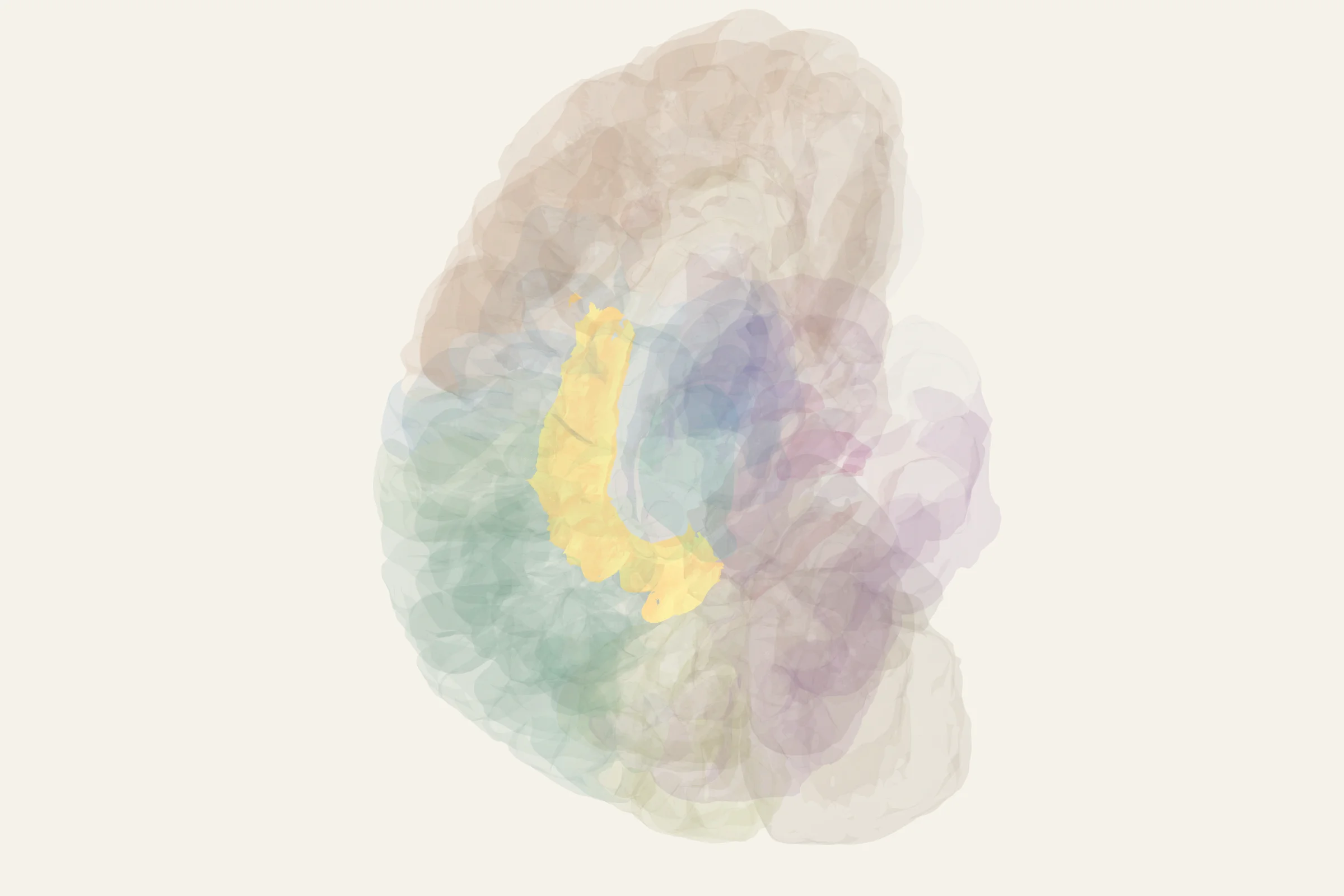
Test this anatomy in the Brain Networks Quiz or open the interactive 3D brain model.
Where is the Posterior Cingulate Cortex located?
Default mode network hub, autobiographical memory, self-referential thought.
What does the Posterior Cingulate Cortex do?
- Default mode network hub — active at rest
- Autobiographical memory retrieval
- Self-referential processing and introspection
- Spatial memory and navigation (retrosplenial)
Posterior Cingulate Cortex pathways and connections
- PCC ↔ mPFC (default mode network core)
- PCC ↔ Hippocampus (memory retrieval)
- PCC ↔ Lateral parietal (angular gyrus — DMN)
What happens when the Posterior Cingulate Cortex is damaged?
- Early amyloid deposition site in Alzheimer's disease
- PCC hypometabolism on PET is an early AD biomarker
- Retrosplenial lesion → topographical disorientation
Posterior Cingulate Cortex key facts
Atlas category: cortical. Brodmann areas or landmark: BA 23, 31 (posterior cingulate), BA 29, 30 (retrosplenial).
- Raichle (2001): discovered the default mode network — PCC is its most consistent hub
- DMN deactivates during focused external tasks — 'task-negative network'
- Abnormal DMN connectivity found in depression, schizophrenia, autism, ADHD
- PCC has one of the highest metabolic rates in the brain at rest
Posterior Cingulate Cortex exam tip
PCC = default mode network hub. Know: DMN = mPFC + PCC + angular gyrus + hippocampus. Active at rest, off during tasks.
Common questions
What does the posterior cingulate cortex do?
It supports autobiographical memory, self-referential processing, internally directed thought and, through retrosplenial regions, spatial navigation.
Why is posterior cingulate cortex important in Alzheimer’s disease?
It can show early amyloid deposition and reduced metabolism, making posterior cingulate change a useful part of the disease’s imaging pattern.
How is posterior cingulate different from anterior cingulate?
Posterior cingulate is a default-mode and memory hub; anterior cingulate is more closely associated with conflict, errors, pain, effort and salience-driven control.