Left Inferior Frontal Gyrus — Function, Location & Quiz
The left inferior frontal gyrus overlaps the territory most students learn as Broca’s area, but memory experiments expose a broader role. Its activity during semantic elaboration can predict whether material will be remembered later—the subsequent memory effect.
Anterior and posterior portions are worth separating: deeper semantic processing leans anterior, while phonological maintenance leans posterior. This distinction explains why damage can weaken effective encoding without looking like a pure loss of short-term storage.
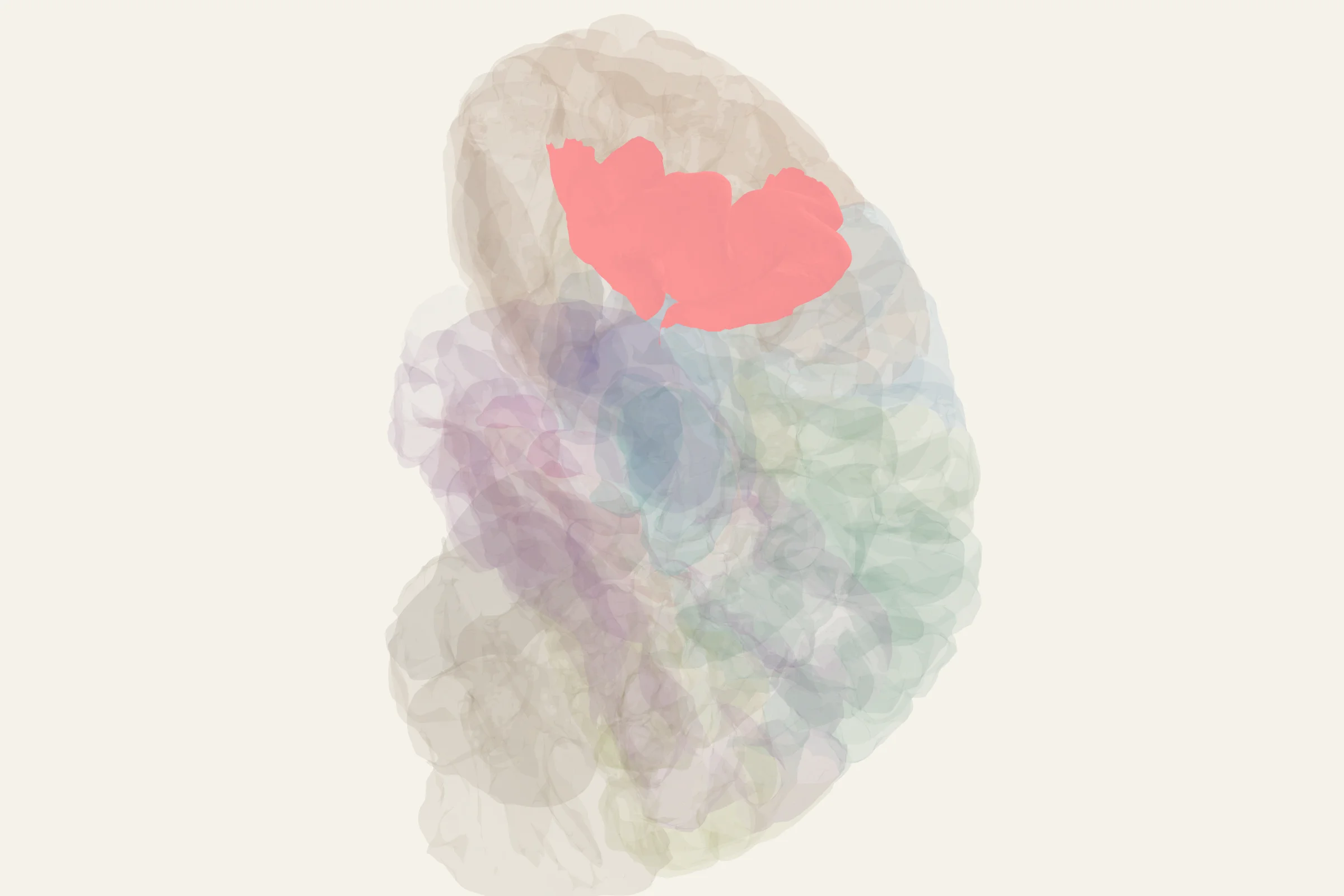
Test this anatomy in the Brodmann Areas Quiz or open the interactive 3D brain model.
Where is the Left Inferior Frontal Gyrus located?
Encoding via semantic and phonological elaboration, overlaps Broca's area.
What does the Left Inferior Frontal Gyrus do?
- Encoding support — anterior LIFG = semantic elaboration, posterior LIFG = phonological rehearsal
- Overlaps with Broca's area but extends into encoding/retrieval functions
- Subsequent memory effect (SME) — activity during encoding predicts later memory success
Left Inferior Frontal Gyrus pathways and connections
- LIFG ↔ Hippocampus (encoding support — deep processing enhances hippocampal binding)
- LIFG ↔ Temporal cortex (semantic retrieval during encoding)
What happens when the Left Inferior Frontal Gyrus is damaged?
- Damage impairs deep (semantic) encoding — shallow encoding may be spared
- Reduced SME in patients with left frontal lesions
Left Inferior Frontal Gyrus key facts
Atlas category: cortical. Brodmann areas or landmark: BA 44, 45, 47 (left inferior frontal gyrus — LIFG).
- Most consistent subsequent memory effect (SME) location across fMRI studies
- Levels of processing (Craik & Lockhart): deep semantic processing in LIFG → better memory
- Anterior LIFG = semantic elaboration. Posterior LIFG = phonological maintenance
Left Inferior Frontal Gyrus exam tip
Left IFG activity during encoding predicts later memory success — the subsequent memory effect (SME).
Common questions
What does the left inferior frontal gyrus do in memory?
It supports semantic elaboration and phonological rehearsal during encoding. Stronger activity during successful encoding is a common subsequent-memory effect.
Is the left inferior frontal gyrus the same as Broca’s area?
They overlap, especially in Brodmann areas 44 and 45, but left inferior frontal functions extend beyond speech production into semantic selection and memory encoding.
How can left inferior frontal damage affect learning?
It can reduce the benefit of deep semantic encoding, making new material less likely to be remembered even when shallower processing remains possible.